What is AI?
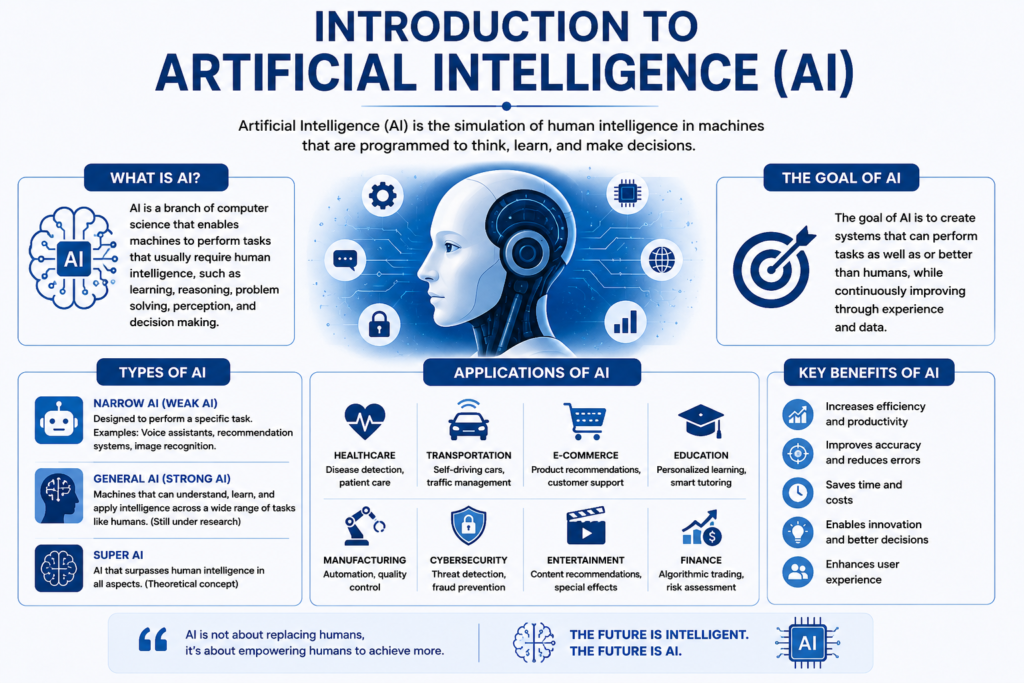
Definition of AI:- Artificial intelligence (AI) is a branch of computer science that provides machines with huma-like intelligence. With AI, machines can learn, make decisions, solve problems, understand language, and improve their actions based on experience.
History of AI:- The history of Artificial Intelligence (AI) dates back several decades. Its concept began in 1950, when Alan Turing raised the question of whether machines could think. He proposed the Turing Test to test the intelligence of machines. Subsequently, in 1956, John McCarthy first used the term “Artificial Intelligence” at the Dartmouth Conference, which is considered the formal birth of AI.
In the 1960s and 1970s, scientists developed computer programs that could solve simple problems. However, due to limited computing power and a lack of data, AI development was slowed at the expected pace. The advent of expert systems in the 1980s gave AI a new direction, but its progress slowed again.
In 1997, IBM’s supercomputer Deep Blue demonstrated the potential of AI by defeating world chess champion Garry Kasparov. In the 21st century, the development of the Internet, big data, cloud computing, and machine learning technologies has taken AI to new heights. Today, AI is being used in many fields, such as healthcare, education, finance, transportation, security, and entertainment, and is considered one of the most important technologies of the future.
How Dose AI Works:- Artificial Intelligence (AI) works with data, algorithms, and computer processing power. The primary purpose of AI is to train machines to learn, think, and make decisions like humans. To do this, AI is given large amounts of data, which it analyzes to identify patterns and relationships.In the process of AI, data is first collected. Machine learning algorithms then study that data and learn rules from it. When AI receives new data, it makes predictions or decisions based on previously learned patterns. If the result is incorrect, the AI learns from its errors and improves its performance.
For example:- when you ask an AI chatbot a question, it uses natural language processing (NLP) techniques to understand your words. It then generates the most appropriate response based on its training data and learned patterns.
Today, AI:- is being used in numerous technologies such as voice assistants, search engines, online translation, medical diagnosis, autonomous vehicles, and recommendation systems, making tasks faster, more accurate, and effective.
Why is AI needed?
In today’s digital age, the need for AI (Artificial Intelligence) is constantly growing. AI helps complete complex and time-consuming tasks faster and with greater accuracy. It analyzes large amounts of data to provide useful insights, enabling better decision-making.
The use of AI increases business productivity, reduces costs, and provides better customer services. In healthcare, AI helps diagnose and treat diseases, while in education, it provides personalized learning experiences. Furthermore, AI can handle repetitive tasks through automation, allowing humans to focus on more creative and important tasks.
Currently, AI is being widely used in services such as smartphones, voice assistants, online shopping, banking, and transportation. Therefore, the need for AI is crucial to making modern life more convenient, secure, and efficient.
Types of AI
Reactive Machines:- Acts only on current information and does not remember past events.
Limited Memory AI:- Able to make decisions using past data and experiences.
Theory of Mind AI:- AI capable of understanding human emotions, thoughts, and intentions.
Self-Aware AI:- Hypothetical advanced AI that understands its own consciousness and emotions.
Narrow AI:- AI designed for a specific task, such as a chatbot or voice assistant.
General AI:- AI capable of performing and learning a variety of tasks like humans.
Super AI:- AI that surpasses human intelligence and outperforms it in all areas.
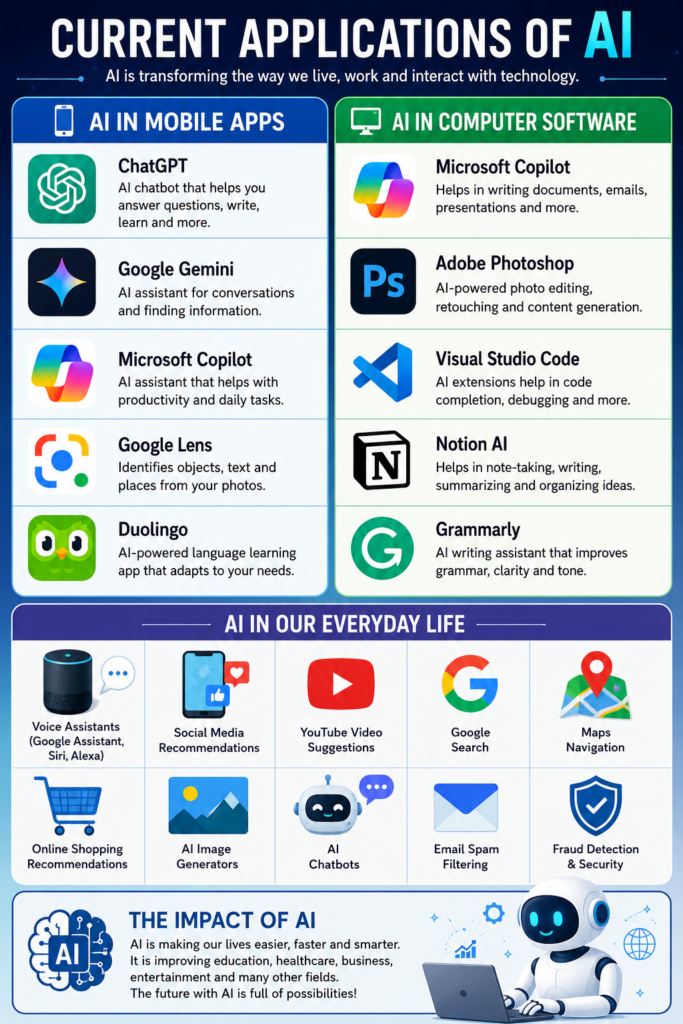
Applications of AI:-
Mobile Apps:-
- ChatGPT – for answering questions, writing, and learning.
- Google Gemini – AI for chat and information retrieval.
- Microsoft Copilot – AI for assistance and productivity tasks.
- Google Lens – for recognizing information from photos.
- Duolingo – for language learning with AI.
Computer Software:-
- Microsoft Copilot – Helps create documents, emails, and presentations.
- Adobe Photoshop – Photo editing and image generation with AI.
- Visual Studio Code – AI-assisted programming.
- Notion AI – for creating notes, writing, and summaries.
- Grammarly – for improving English writing.
Where is AI used in everyday life?
Voice Assistants (Google Assistant, Siri)
Social Media Recommendations
YouTube Video
SuggestionsGoogle Search
Maps NavigationOnline
Shopping Recommendations
AI Image
GeneratorsAI
Chatbots
AI in Our Daily Lives:-
Artificial Intelligence (AI) has become a vital part of our lives today. It makes tedious and time-consuming tasks faster, easier, and more accurate. With AI, we can access information quickly, receive better online shopping recommendations, and more effectively use smartphones, computers, and other devices.
In education, AI provides students with a personalized learning experience. In healthcare, it helps doctors diagnose and treat diseases. In businesses, AI improves data analysis, customer service, and decision-making.
In addition, AI plays a vital role in areas such as traffic management, security systems, banking services, and entertainment. AI increases productivity, reduces human errors, and saves time. Therefore, in the modern era, AI is crucial for making human life more convenient, secure, and advanced.
Advantages and Disadvantages of AI:-
Advantages of AI
- Fast Work – AI can accomplish significant tasks in a very short time.
- 24/7 Availability – AI can work continuously without getting tired.
- Reduced Errors – AI makes fewer mistakes when provided with accurate data.
- Increases Productivity – It completes tasks more efficiently.
- Data Analysis – It quickly understands large amounts of data and provides useful information.
- Helps in Healthcare – It helps in disease identification and treatment.
- Useful in Education – It provides personalized learning and online assistance.
Disadvantages of AI:-
- Impact on employment – Demand for some jobs may decrease.
- Higher costs – AI systems can be expensive to build and maintain.
- Lack of human emotions – AI does not understand emotions the same way humans do.
- Data security issues – Privacy and security risks may arise.
- Technological dependency – People may become overly dependent on AI.
- Risk of incorrect decisions – AI can also give incorrect results based on incorrect or biased data.
- Potential for misuse – Fake content can be used for cyber attacks and misinformation.